Is battery export in the evenings worth the hassle?
Battery export plans pay an evening feed-in tariff of about 29c a kWh from 5 to 9 pm. A good solar plan pays 8 to 12c for your first 8 to 10 kWh a day, then 3c. For a typical NSW home with solar and battery the difference is about $100 a summer, and you have to set up and watch the exports to earn it.
By Serg · Updated 20 Nov 2026 · 5 min read
What you're really comparing
The fair comparison isn't 29c against 3c. It's a battery export plan against the best plain solar plan you could be on. The battery plan pays more only for what your battery sells in the evening, and just 3c for daytime solar.
| Battery export plan | Good solar plan | |
|---|---|---|
| Example (Ausgrid) | Origin Battery Earner | EnergyAustralia Solar Max |
| Solar export | 29c from 5 to 9 pm 3c at all other times | 8c for the first 10 kWh each day 3c after that, at any time |
| Usage | 54.0c from 5 to 9 pm 29.8c at all other times | 33.1c at any time |
| Supply | 139.0c / day | 170.8c / day |
Origin Battery Earner (ORI1206294MRE1) and EnergyAustralia Solar Max (single rate), as published on the government's Energy Made Easy feed on 10 Nov 2026. Incl. GST, rounded.
A summer day, side by side
Take a home with 26 kWh of spare solar, where the battery could sell 6 kWh in the evening. On the solar plan those 6 kWh stay in the battery, so the same amount goes out as daytime solar instead.
| Battery export plan | Good solar plan | |
|---|---|---|
| Daytime solar export | 20 kWh: 60c | 26 kWh: $1.28 |
| Evening battery export | 6 kWh: $1.74 | – |
| Battery wear (5c / kWh) | −30c | – |
| Export income per day | $2.04 | $1.28 |
Solar plan: the first 10 kWh at 8c, the other 16 kWh at 3c.
So the battery export plan earns 76c a day more. Over a summer (151 days, November to March) that adds up to:
| Battery charge to spare each evening | 4 kWh | 6 kWh | 10 kWh |
|---|---|---|---|
| Extra export income over a summer | about $50 | about $115 | about $240 |
These are export earnings only. The two plans' supply and usage charges differ too, and can add to the gain or wipe it out, so compare whole bills, not just the feed-in tariff.
How to make it pay, and what it takes
- Let solar fill the battery during the day.
- Run the house on the battery in the early evening, while you cook and the air-con runs.
- Export late in the window, say 7 to 9 pm, with a scheduled (forced) discharge in your battery app.
- Size the export for an average day, not a sunny one. Over-exporting wears the battery, and you buy the power back at 29.8c, or 54c before 9 pm.
- Set a reserve level so exporting stops with enough left for the night.
- Check it worked after a cloudy day or a hot evening, and adjust.
Don't sell what you'll buy back. On Battery Earner overnight power costs 29.8c, more than the 29c export credit, so only sell charge that would still be in the battery at sunrise. Check the plan's export caps and eligibility too, and plan to switch back to a solar plan in autumn.
Summer only
Evening export is a summer play. From about October to March long days fill the battery with charge to spare. In winter you use most of your solar yourself, so there's little to sell while the 54c peak still applies. The same plan can be best in January and poor in July, which is why SeasonSwitch ranks plans for summer and winter separately.
Battery wear
Every kWh through the battery uses a little of its life: replacement cost ÷ (usable kWh × cycles). Use what a replacement would cost today, not the discounted price you paid, and the cycle rating from the spec sheet. A 10-year warranty is about one cycle a day, and many warranties also cap the total energy put through.
As entered in SeasonSwitch: Compare › Your home › Battery
Battery cost
Full cycles
Battery wear
$6,000 ÷ (18.0 kWh × 4,000 cycles) = 8.3c per kWh
Wear of 3.7 to 8.3c puts the summer-day gain above at about $85 to $127.
Key takeaways
- Judge an evening feed-in tariff against a good solar plan, not against 3c.
- With about 6 kWh spare a night it's worth $100 or more a summer. Under about 4 kWh, a good solar plan pays nearly as much with no hassle.
- You need charge left at sunrise (check your app's history) and an app that can schedule exports and keep a reserve.
- It pays in summer only, so plan to switch back in autumn.
- Count battery wear, and never sell what you'll buy back overnight.
Plan it in SeasonSwitch
- In Your home → Battery, enter its size, cost and cycles, and answer Yes to exporting in the evening.
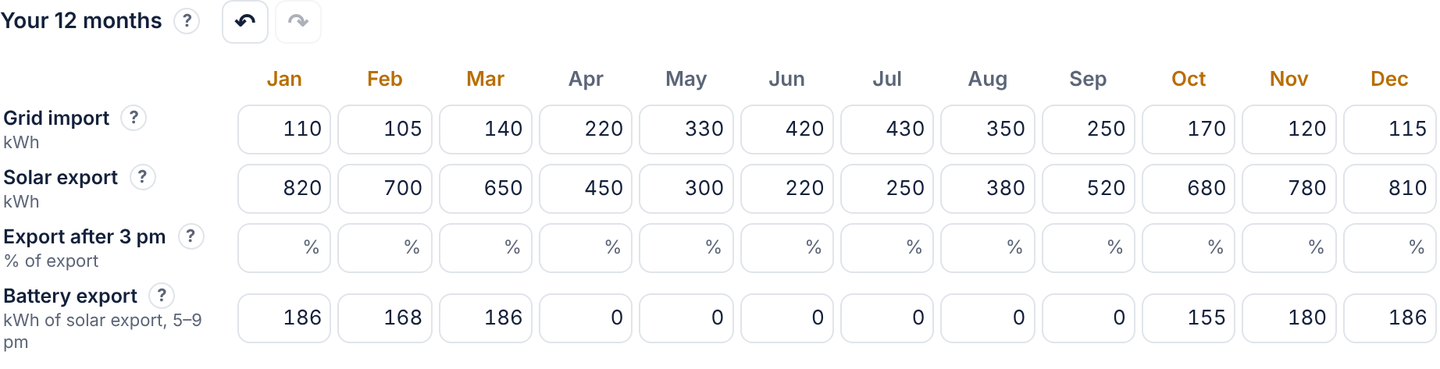
- In Your usage, a Battery export row appears in the 12-month table. For each summer month, enter what you could sell from 5 to 9 pm: spare kWh a night × days, e.g. 6 × 31 = 186.
- The Summer results now cost battery export plans with that figure, against every solar plan. Run it again with the row at 0 to see what evening export is really worth to you.
Would a battery export plan beat a good solar plan for you?
See it costed on your own numbers, for summer and for winter.